Growing Postal
In a surprising turn of events, fringe is found to not scale that well.
Has it been getting lonely lately? Are all of your friends dead, figuratively?
What I like about mythology the most is its ability to compress the bottom line to ridiculously short stories: the kind you learn to understand the second before you need them.
There’s a myth I found helpful in explaining community splits. You might have seen this process before, perhaps more than once. Today, we’ll answer the questions of how and why this happens, allowing us to derive a new future-proof strategy. Fasten your seatbelts, dear reader ― we’re going biblical!1
The story arc
The road of excess leads to the palace of wisdom… You never know what is enough until you know what is more than enough.
― William Blake, Proverbs of Hell
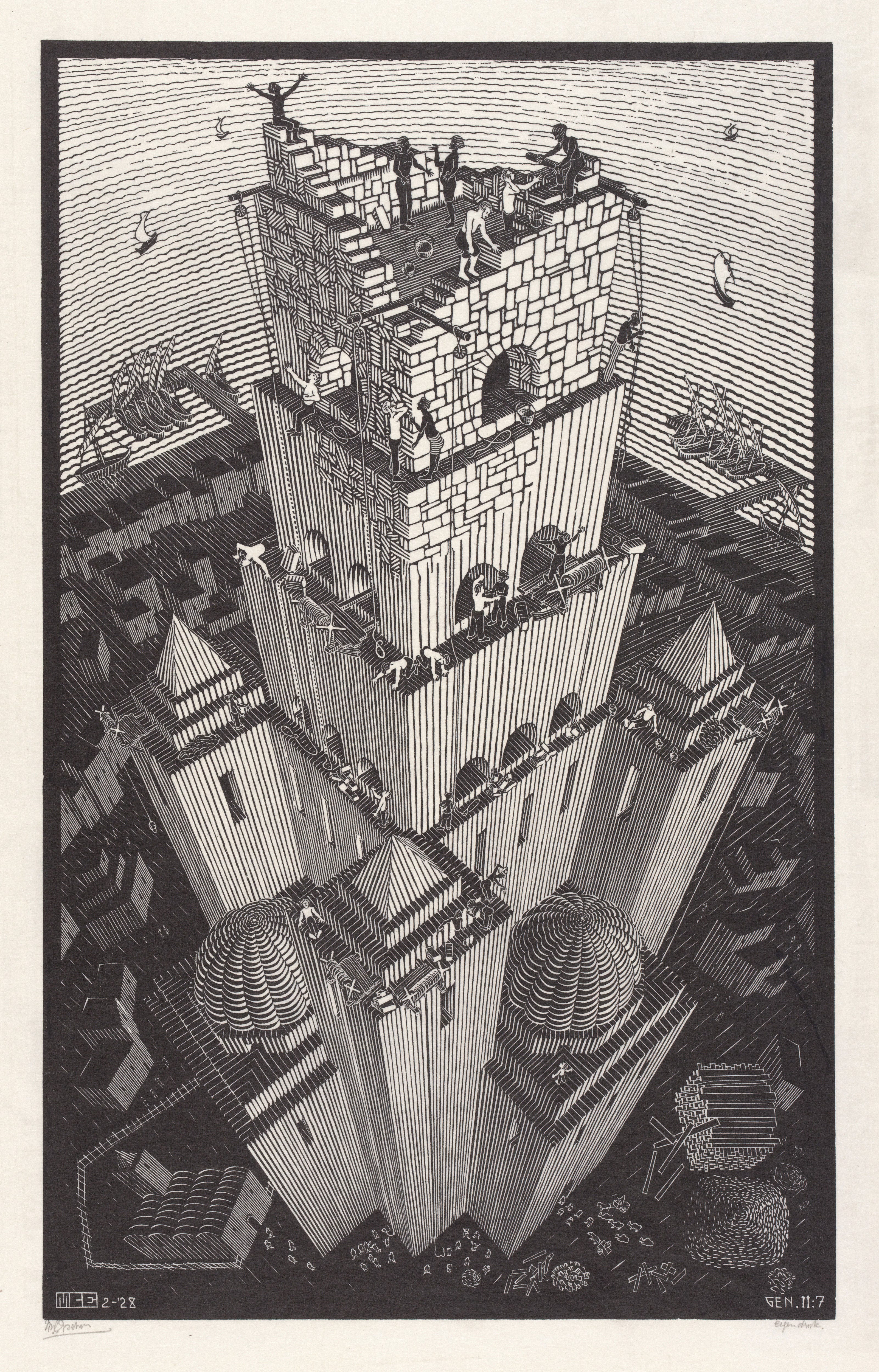
Did you like that tower up there? It’s the architecture of your life. Let me explain.
Foundation
It starts with stability, or the good times. Your club, company, or team (whichever applies) has options, curiosity, and hope. You’re open to new experiences, and you’re using an opportunity to broaden your worldview and bring in more people into the mix.
The middle
You appreciate the differences, for the most part. After all, life would be boring without them. However, after a while, you begin to recognize that you’re dead serious about some of the inconsistencies.
You know good results require effort, so you start giving out subtle, then not so subtle clues ― surely they’re reasonable! The newcomers can hear you, may realize you’re upset, or even take corrective actions. Yet their attempts always fall short of your expectations, and not for lack of trying.
The tip
Having realized that removing friction from your life would earn you back some of the much-needed energy, you look for new opportunities below. The cycle of life starts anew, and it’s time to build another tower, or a weird Escherian offshoot ― hope you brought a parachute!
Examples in history
People come and go all the time. Frequently this is tacitly acknowledged as part of life, but now and then we get signals that we can’t ignore. Accurately interpreting those will give us insights into the trajectory of your group. Later on, you might even be able to put a finger on a single pivotal event that had changed everything, and give it a funny name such as “The Big RIP”. This will enable you to process the loss, move on, and start again.
Eternal September
While I occasionally enjoy a good Wikipedia run, and I while had the unusual honor of being acquainted with Clifford Stoll’s books at an early age, I’m not a technology historian, so take anything I write here with a grain of salt.
We're whalers on the Moon, we carry a harpoon. But there ain't no whales so we tell tall tales and sing a whaling tune.
― Futurama describing the Apollo program
The Internet as we know it today started out as a research project funded by the Department of Defense. Involving technical universities in the enterprise was a natural choice. This setting netted a lot of scientists and technology professionals communicating over the network ― something that will become important later on as we explore the subject.
For a while, the systems used to exchange information couldn’t be separated from the network itself. If you wanted to communicate, you did that over Usenet, or E-mail. Sure, there were shared computer systems, and each university had their own servers, but that was entirely due to technical constraints. Similarly, one did not start an isolated BBS to avoid the main network, but because it was difficult to become a part of it.
The early Internet filtered for dedication. One did not simply stumble and fall into the net. Not only that: being there wasn’t even attainable outside of academia, and professional settings, unless you had an expensive technical hobby.
These odds meant a typical netizen was a member of the middle class as it existed then and there: fortunate enough to be well-connected, knowledgeable, relatively secure, and having at least some proclivity toward the Protestant work ethic.
Early Internet users brought their values with them, influencing their definitions of good, bad, and tolerable. Those values were codified in the netiquette used to moderate shared content. Active moderation remained an effective strategy for a while, and it seems pre-1994 misuse of the commons was still rare:
Spam in the modern sense began in 1994 when two "gentlemen" named Cantor and Siegel posted an advertisement for "Green Card Lottery". They posted this message to 6,000 newsgroups at the same time. They continued posting for some time, and reportedly made some money from their efforts. This didn't save them, however, from becoming two of the most hated people on the entire internet.
― mailmsg.com, History Of Spam
Today, no one would bat an eye at online grift.
Around mid-90s, things began to change. Popularization of Internet access removed some of the effort from the filter equation, leading to the so-called Eternal September effect. The consensus is that a sudden influx of new users overwhelmed the capacity to moderate, but I disagree.
Enjoying cohesion is not in the cards once you go mainstream, regardless of how much resources you’re willing to dedicate to keep things going the old way.2
As the Internet became saturated, those who already spent years on it felt the difference and went elsewhere. Services facilitating the exchange of information, like Usenet, gradually ceased to be synonymous with the network itself. You could still use them, it’s just that you wouldn’t get the same outcomes.
What came later was a culture of smaller Web 2.0 forums, each with their own rules and expectations. Then, even more people became acquainted with the Internet through social networks like Facebook.
I jumped off sometime in the early 2010s ― that is to say I’m still here, but this space as a whole no longer feels familiar. I found refuge in smaller projects.
The drowning of Hacker News
Hacker News is a business-technical site started around 2007 in reaction to overcrowding of another community: Reddit3. Anecdotally, my circle of friends had regarded it as a prime place for a hacker to lose time on for close to a decade now. Other than perceptions of slow decay, however, there hadn’t been a single tectonic event that could be interpreted as a signal that things were about to change, until February 2026, when a damning thread titled Is Show HN dead? No, but it’s drowning bubbled up to the front page.
Show HN is a category where hackers announce their projects, be it an application, a website, or a service. The quality of submissions is ensured by both popularity of the site and the effort it takes to produce something popular.
Proliferation of automated coding tools (so-called AI or LLM-based) lowered the effort required to make an HN-style project in a way that’s not obvious at first glance. Because one no longer needs to put in the effort to post there, one also no longer needs to be persistent either while producing source code, or more importantly, at the ideation stage. In this way, the unaware and the lazy were invited to the party. Then, much like after AOL et al. got more of us on the Internet, the music stopped.
As far as I’m aware, the site’s graybeards have yet to decide on where to go next.
The policy of deny-by-default in post-LLM F/OSS
Using persistence as a proxy, a well-formed patch4 used to signal that a great deal of thought had gone into source code put into review. Such an arrangement made it easy for software maintainers to spot contributions that saved their time: first by reducing their cognitive burden, and second by integrating a solution.
Nowadays, using the tools mentioned, it’s easy to generate solutions that look correct, but don’t manage to distill the underlying problem. It’s because software was only ever a byproduct. The real value still lies in insight, relationships, and persistence.
Free and Open Source Software5 worked as long as it was practical and beneficial to share insight across broad groups. In the future, participating in a project like that might require you to make friends with its leaders before presenting your input, as trust becomes no longer implied or even expected.
There’s more
You’ll see it everywhere: in mass market video games, the fall of Compaq, cute corporate mottos, Berlin’s hackerspace scene, and YouTube vs Vimeo. It seems this process is inevitable, and it accelerates together with each community’s size. Once a critical mass is reached, sub-communities start to form.
Drawing lines in the sand
It’s worth asking why the uninitiated won’t simply listen. In each case, guidance was readily available, and yet it never created the stability that everyone had wanted. Assigning blame is as easy as it’s counterproductive6. We instead should remember to never attribute to malice what can be adequately explained by stupidity.7
Stupidity doesn’t necessarily mean low IQ or lack of education. Rather, the stupid repeatedly take actions that cause losses to both themselves and others8 regardless of what causes them to do so. One can be intelligent, and still out of touch.
There are limits to how much context we can share. Whatever brought the original group together doesn’t generalize to the broader world. That’s even before we bring in generational differences9 into the conversation. We’re limited both by our numbers and the time we have.
Without shared context, your message will be lost in translation.10 This creates confusion, slowing you down. This problem has been known for a while already. Here’s a fist-bump ~700 years in the making:
As many as were the types of work involved in the enterprise, so many were the languages by which the human race was fragmented; and the more skill required for the type of work, the more rudimentary and barbaric the language they now spoke. But the holy tongue remained to those who had neither joined in the project nor praised it, but instead, thoroughly disdaining it, had made fun of the builders' stupidity.
―Dante Alighieri, De vulgari eloquentia
Note that the word language doesn’t have to be taken literally. Language is also anything you do to communicate. This can include observing social norms, or limiting the first line of your patch to 75 characters like Linus intended.
For a long time I held an assumption that knowledge sharing was a convergent process, and it may well be, but at a small scale. I wouldn’t hold my breath for a global consensus to occur.
It’s worth considering the needs your community serves. Some will find you looking for camaraderie, others will appreciate technical riddles, and some will aim to progress professionally.11 Each group will have a different outlook on what’s desirable, so you might like to predict your future with the help of an appropriate Venn diagram.
Leave and let live
Starting over is difficult, but we can’t stay12. What can we do about this conundrum? We should embrace any community with a non-flat trajectory as ephemeral, and accept their impermanence as a part of life. It’s way better than just going through the motions long after the lights went out. Your conscientiousness will best serve you if redirected elsewhere.
Attempts at cultural preservation are ultimately bound to fail both on the community and personal levels. You’re a gift of a long evolutionary process. Don’t tell me you’re going to stop now. Culture stays the same only as long as it’s beneficial to keep it.
It’s going to fall apart. What’s the use in worrying? It’s inevitable.
― Hayao Miyazaki on the future of Studio Ghibli
I like that he doesn’t plan on turning the studio into a hollowed-out husk, Disney-style.
On a lighter note: splitting into smaller groups may bring enormous benefits. Sure, you will no longer hear about everything the other people are doing, but the important facts will find a way to reach you. Also, going your own way can create the much needed space for more things to happen.
In times of volatility we find ourselves looking for our place again. It follows that now is a great time to start a new community, as there’s increased demand for connection. You’re ready ― you’ve seen the complete cycle before, so if any of this currently bothers you, just go on and do it!
“A piece of data intended to modify a computer file by replacing a part of it” ― Wiktionary
I believe it still makes sense to keep the distinction.
Albert Camus, Exile and the Kingdom